
.png)
Climate adaptation strategies

The Mekong Delta (MKD) is globally recognized as one of the river deltas most severely impacted by climate change. The region is confronting a series of critical challenges, including: sea-level rise, increasingly deep saltwater intrusion into the hinterland, rising frequency and intensity of droughts, erratic flooding, riverbank and coastal erosion, and land subsidence. According to climate change scenarios developed by the Ministry of Natural Resources and Environment, a one-meter sea-level rise would put approximately 39% of the MKD at risk of inundation, directly affecting the lives of nearly 18 million residents and threatening national food security. Recognizing the gravity of this situation, the Government of Vietnam has promulgated and implemented numerous strategic policies aimed at climate adaptation in the Mekong Delta.
Key Policy Frameworks
Resolution No. 120/NQ-CP – The "Nature-Based" Strategic Foundation
Resolution No. 120/NQ-CP, issued by the Government on November 17, 2017, regarding the sustainable development of the Mekong Delta in adaptation to climate change, is considered a landmark strategic document. It serves as the foundation for the entire adaptation policy system in the region. The Resolution establishes a core philosophy of "Thuan Thien" (Nature-Based)—respecting natural laws and shifting the development paradigm from a "struggle against nature" to "proactive adaptation." Key orientations include: restructuring agricultural production to align with specific ecological sub-regions (freshwater, brackish, and saline zones); developing multi-purpose hydraulic infrastructure; conserving natural ecosystems; and fostering economic development in a "nature-based" direction, effectively transforming climate challenges into development opportunities.
Mekong Delta Regional Plan for 2021–2030, Vision to 2050
Decision No. 287/QD-TTg, dated February 28, 2022, approved the Mekong Delta Regional Plan—the first regional plan in the country to be approved under the 2017 Planning Law. This plan integrates climate adaptation elements throughout, dividing the MKD into three ecological sub-regions (upstream freshwater storage, middle transition, and coastal zones) to apply appropriate adaptation strategies for each. Specific solutions include: transitioning from triple-cropping rice to double-cropping or rice-aquaculture rotations in saline-affected areas; developing decentralized freshwater storage systems; establishing natural flood drainage corridors; planning living spaces adapted to inundation; and developing climate-resilient urban areas.
National Adaptation Plan for 2021–2030, Vision to 2050 (NAP)
Decision No. 1055/QD-TTg, dated July 20, 2020, approved the National Adaptation Plan (NAP), in which the Mekong Delta is identified as a top-priority region. The NAP outlines key adaptation solutions for the MKD: upgrading early disaster warning systems; developing response scenarios for sea-level rise and saltwater intrusion; developing salt- and drought-tolerant crop and livestock varieties; protecting and restoring coastal mangroves; building climate-resilient infrastructure; and strengthening the adaptive capacity of vulnerable communities.
National Strategy on Climate Change to 2050
Decision No. 896/QD-TTg, dated July 26, 2022, approved the National Strategy on Climate Change to 2050, further reaffirming the MKD as a focal point for adaptation. The strategy emphasizes key objectives: minimizing losses caused by climate change to agricultural production and livelihoods; developing Climate-Smart Agriculture (CSA); constructing resilient infrastructure systems; and ensuring water security amidst the increasing uncertainty of upstream Mekong River water sources.
National Strategy on Climate Change to 2050
The Government has approved several large-scale climate adaptation infrastructure projects in the MKD for the 2021–2025 period:
-
Mekong Delta Integrated Climate Resilience and Sustainable Livelihoods Project (MD-ICRSL): Funded by the World Bank with a total capital of approximately $387 million USD, focusing on salinity control infrastructure, water management, and adaptive livelihood development in coastal provinces.
-
Cai Lon – Cai Be Irrigation System (Kien Giang): Designed to control salinity, retain freshwater, and proactively regulate water for approximately 384,000 hectares of production land.
-
Sea Dyke Consolidation and Upgrading Program: Stretching from Ca Mau to Kien Giang, combined with protective mangrove reforestation to create a natural defense line against sea-level rise and storm surges.
Adaptive Agricultural Transformation Policies

The Ministry of Agriculture and Rural Development has implemented the Agricultural Restructuring Plan for the Mekong Delta, centering on shifting crop and livestock structures to suit climate change conditions. Specifically: reducing triple-cropping rice areas in coastal regions; developing rice-shrimp and rice-fish models; cultivating salt-tolerant fruit trees; encouraging water-saving irrigation technologies; developing circular and organic agriculture; and supporting farmers in accessing climate-resilient varieties developed by domestic research institutes.
International Cooperation on Climate Adaptation
Vietnam has actively collaborated with numerous international partners to implement climate adaptation programs in the MKD. Notable examples include cooperation with the Netherlands through the Mekong Delta Plan, sharing expertise in water management and lowland planning; and partnerships with the World Bank, UNDP, GIZ, and JICA on projects for adaptive capacity building, green infrastructure development, and support for vulnerable groups. Additionally, Vietnam’s Net Zero 2050 commitment at COP26 and updated Nationally Determined Contributions (NDCs) place the MKD at the heart of the national adaptation strategy.
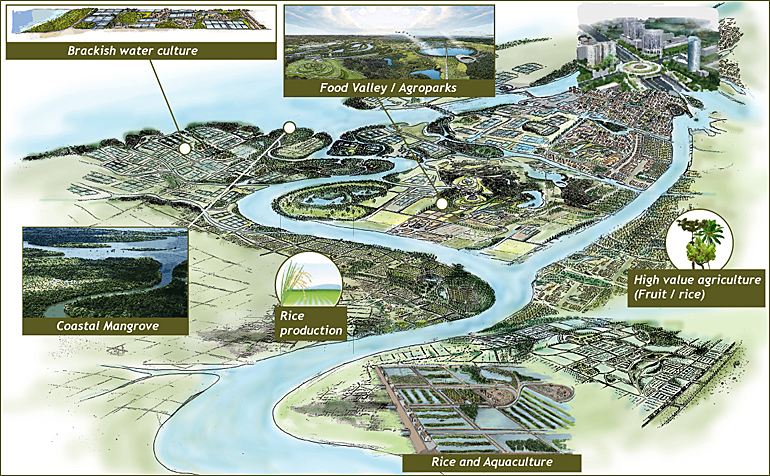
Figure: The plan for integrated aquaculture and vegetable cultivation was officially presented by Dutch Minister Schultz in Hanoi, Vietnam.
Assessment and Recommendations
The current climate adaptation policy system for the MKD is relatively comprehensive, ranging from national strategies to regional planning and specific infrastructure projects. The "Nature-Based" philosophy of Resolution 120 has catalyzed a significant shift in thinking and is highly regarded by the international community. However, implementation still faces numerous challenges: a major shortfall in financial resources for adaptation projects; suboptimal inter-sectoral and inter-provincial coordination; limited local-level forecasting and early warning capabilities; and insufficient access to information and resources for poor farmers and fishers to transition their livelihoods.
Therefore, it is essential to continue diversifying adaptation financing, including international climate finance, green bonds, and private sector mobilization. There is a need to strengthen regional coordination mechanisms to ensure connectivity in water resource management and disaster response. Furthermore, the application of digital technologies in climate monitoring, smart water management, and early warning should be accelerated. Finally, enhancing community adaptive capacity through training and direct support for vulnerable populations is crucial to ensure that "no one is left behind" in the process of adapting to climate change in the Mekong Delta.