
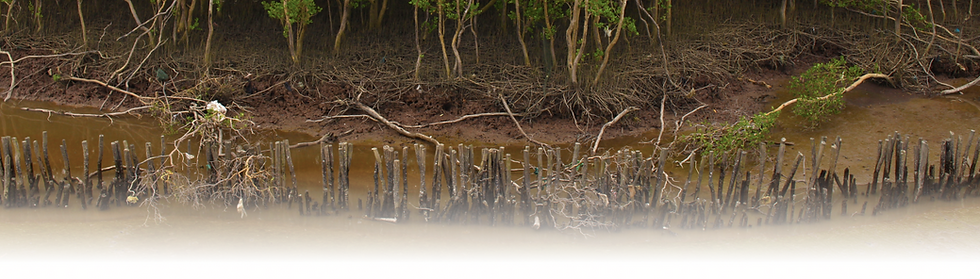
WOODEN FENCES
Wooden fences, primarily constructed from bamboo or local melaleuca wood, have emerged as a critical nature-based solution (NbS) for managing coastal erosion and land loss in the Vietnamese Mekong Delta. These permeable structures are strategically placed in intertidal zones to serve as "soft" engineering interventions that mimic the natural wave-damping properties of mangrove forests (Quang, 2025). By reducing the velocity of incoming waves and currents, these fences create a low-energy environment—a "shelter zone"—where suspended sediments can settle out of the water column and accumulate on the seabed (Albers et al., 2013). This process of sediment capture is vital for elevating the substrate to levels suitable for the natural recruitment or manual planting of mangrove species, which otherwise cannot survive in high-energy, eroding environments (Schmitt et al., 2013).

The effectiveness of these fences is highly dependent on their porosity and structural configuration. Research indicates that a fence with a porosity of approximately 50% can achieve significant wave height reductions, ranging from 11% to over 70% depending on the wave period and water depth (ResearchGate, 2026). Common designs include "T-fences," which consist of a main fence line parallel to the shore connected to perpendicular "cross-fences." This layout is particularly effective at trapping sediment by preventing longshore currents from washing away newly deposited silt (Albers et al., 2013). Some variants utilize bundles of brushwood or melaleuca branches packed between two rows of bamboo poles; these "dense" bundles enhance energy dissipation through friction and the formation of micro-vortices within the structure (Mai et al., 2020).
While these wooden fences are an environmentally friendly alternative to "hard" solutions like concrete seawalls, they are considered temporary interventions with a limited operational lifespan. Typically, bamboo fences last between two to three years before they begin to decompose due to saltwater exposure and wood-boring organisms (PMC, 2022). Consequently, they require frequent maintenance and regular replacement until the established mangrove forest is mature enough to perform the wave-damping and sediment-trapping functions autonomously. Despite these maintenance challenges, they remain a preferred solution in the Mekong Delta because they are cost-effective, utilize local materials, and facilitate the restoration of natural ecosystems rather than just providing a physical barrier (CTU Journal, 2026).